

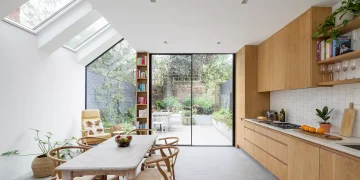





Co-living is a housing model where individuals rent private rooms but share common spaces like kitchens, living rooms, and bathrooms. It’s similar to having roommates, but with added convenience. Many co-living developments offer furnished rooms, cleaning services, and built-in social events. Most importantly, they handle roommate vetting — a major relief for newcomers.
Jasper chose Colette, a modern apartment building in D.C. that offers both traditional rentals and co-living units. For $1,400 a month, he gets a fully furnished private room in a five-bedroom apartment. His rent includes high-speed WiFi, cable, and biweekly cleaning. Unlike traditional roommate setups, Colette screens all tenants for financial stability and background history — eliminating the guesswork.
Because the building manages roommate matching, Jasper didn’t have to post ads or interview strangers. “It takes a lot of headache and stress out of the equation when your leasing company takes charge of doing the vetting, background checks, and financial checks,” he said. “It’s definitely a lot easier than putting an ad on Craigslist and hoping for the best.”
In just two months, Jasper and his roommate have built a positive, respectful dynamic. He’s also saving significantly — his rent is $755 below D.C.’s median of $2,155. For young professionals in expensive cities, this kind of affordability is transformative.
Co-Living’s Rising Popularity
Since the mid-2010s, co-living has gained traction among millennials and Gen Z, especially in high-cost urban areas. Startups have marketed it as an affordable, social alternative to traditional rentals — often calling it “adult dorm life.” Digital nomads and remote workers especially value the ready-made community and flexible leases.
But co-living is more than just a lifestyle trend. It’s emerging as a viable solution to deeper housing challenges. According to the U.S. Census, nearly half of all renters in 2023 were rent-burdened, spending over 30% of their income on housing.
At the same time, many U.S. cities face a surplus of empty office space. The shift to remote and hybrid work has left downtowns with high vacancy rates. This dual crisis — too many empty offices and too little affordable housing — has sparked a bold idea: convert office buildings into co-living spaces.
A Sustainable Solution for Cities
Terry Hogan, a market analyst at global design firm Gensler, partnered with The Pew Charitable Trusts to study this model. Their research focuses on transforming underused office floors into co-living units that are both affordable and efficient.
In their proposed design, each resident gets a private bedroom, while kitchens, bathrooms, and lounges are shared across the floor — similar to dorm layouts. This approach avoids the costly process of adding individual plumbing and HVAC systems to each unit, cutting construction costs by 25% to 35% per square foot compared to standard conversions.
“You would essentially create an affordable alternative to what’s currently on the market,” Hogan explained, “one that fits the income range of a much larger slice of the population.”
The study targeted cities with high downtown vacancies and housing shortages — including Chicago, Los Angeles, Seattle, Houston, and Washington, D.C. In Chicago, for example, a shared co-living unit could rent for as low as $750 per month, far below the city’s $1,663 median rent.
From Concept to Reality
While most co-living buildings today — like Colette — are newly built, the office-to-co-living model is gaining attention. According to RentCafe, nearly 71,000 apartment units are being converted from office space in 2025 — a 28% increase from 2024 and a 206% jump from 2022.
Still, large-scale co-living conversions remain largely conceptual. Zoning laws, building codes, and financing hurdles must be addressed. However, the growing demand for affordable, community-oriented housing suggests strong potential.
As Hogan noted, “Co-living is evolving and becoming quite attractive in a lot of markets across the country right now. And that is, I think, reflective of the needs of renters.”
For people like Jasper, co-living offers more than savings — it offers connection, convenience, and peace of mind. And for cities, it could be a key to solving two problems at once: housing affordability and urban revitalization.
Ultimately, co-living isn’t just a housing trend. It’s a reimagining of how we live, work, and belong in modern cities.