




In hospitals, schools, and busy commercial interiors, flooring rarely gets attention until it fails. That reality is precisely where iQ Motion flooring enters the conversation, offering a blend of durability, design, and sustainability aimed at environments that demand consistent performance.
The launch of iQ Motion flooring marks a strategic evolution for Tarkett, which continues to position its iQ range as a benchmark in homogeneous vinyl surfaces. The new collection builds on that legacy, targeting architects and facility managers who need materials that can endure heavy use without compromising aesthetics.
Built on a Proven Flooring System
At its core, iQ Motion flooring is a homogeneous vinyl product. This means it consists of a single, uniform layer of material, rather than multiple bonded layers. That structure plays a crucial role in its resilience.
Unlike layered flooring systems that may wear unevenly, homogeneous vinyl maintains consistent performance over time. For high-traffic environments such as healthcare facilities and educational institutions, this translates into longer service life and reduced maintenance disruptions.
According to Tarkett, the iQ range has long been regarded as one of the highest-performing options in its category. The introduction of iQ Motion flooring extends that positioning while introducing new visual and environmental features.
Designed for Demanding Environments
Durability remains the defining feature of iQ Motion flooring. The material is engineered to resist scratches, stains, and wear, even under constant foot traffic. This makes it particularly suitable for spaces where hygiene and reliability are critical.
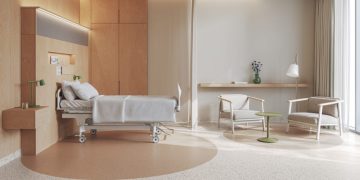
Healthcare settings, for example, require surfaces that can withstand frequent cleaning and disinfecting. Schools and public buildings demand flooring that maintains appearance despite heavy daily use. In these contexts, performance is not just a preference but a requirement.
One of the more distinctive claims surrounding iQ Motion flooring is its ability to be restored while still in use. This capability allows facility managers to maintain surface quality without shutting down operations, a significant advantage in environments where downtime is costly.
Aesthetic Shift Inspired by Terrazzo
While performance anchors the product, design gives iQ Motion flooring its identity. The collection introduces a palette of 16 natural tones, each featuring a speckled, mosaic-like finish inspired by terrazzo.
This design approach reflects a broader trend in interior architecture, where functional materials are expected to contribute to visual coherence. The subtle patterns in iQ Motion flooring help conceal wear while adding texture and depth to spaces.
Colors range from deep, moody blues to softer, earthy hues. This variety allows designers to create environments that feel both practical and expressive, without sacrificing durability.
Importantly, the collection is designed to integrate seamlessly with other iQ products. This compatibility supports cohesive design strategies across large or multi-use facilities.
Sustainability and Circular Design
Sustainability plays a central role in the positioning of iQ Motion flooring. The product is fully recyclable and can be returned to the manufacturer at the end of its life cycle.
This approach aligns with circular design principles, where materials are reused rather than discarded. For large-scale projects, this can significantly reduce environmental impact over time.
Tarkett states that its iQ range has one of the lowest circular carbon footprints in the homogeneous vinyl category. The company attributes this to continuous efforts to refine production processes and material efficiency.
Such claims reflect a growing expectation within the construction industry. Clients increasingly demand materials that not only perform well but also contribute to broader sustainability goals.
Long-Term Performance and Warranty Confidence
A 20-year warranty accompanies iQ Motion flooring, signaling confidence in its long-term durability. For facility operators, this assurance reduces risk and supports investment decisions.
Lifecycle costs often outweigh initial installation expenses in commercial settings. Flooring that lasts longer and requires less maintenance can deliver significant savings over time.
The ability to restore the surface, combined with its resistance to damage, further strengthens its value proposition. It shifts the focus from replacement to maintenance, aligning with both economic and environmental priorities.
Expanding a Legacy Portfolio
The introduction of iQ Motion flooring represents more than a product launch. It reflects a broader strategy by Tarkett to expand its influence in performance-driven design solutions.
With a history spanning more than a century, the company has consistently adapted to changing industry demands. Recent developments, including efforts to achieve carbon-negative linoleum production, highlight its focus on sustainability alongside innovation.
The iQ Motion collection fits within that trajectory. It combines technical refinement with a renewed emphasis on aesthetics and circularity, responding to the evolving needs of modern architecture.
The Future of High-Performance Flooring
As buildings become more complex and user expectations rise, materials must do more than serve a single function. iQ Motion flooring illustrates how performance, design, and sustainability can converge in a single solution.
For architects and developers, the challenge lies in balancing these priorities without compromise. Products that meet all three criteria will increasingly define the next generation of built environments.
In that context, iQ Motion flooring signals a shift toward smarter material choices. It suggests that durability no longer has to come at the expense of design, and that sustainability can be integrated from the outset rather than added later.
The broader implication is clear. Flooring, once considered a background element, is becoming a strategic component of architectural design. And as that shift continues, solutions that combine resilience, adaptability, and environmental responsibility will shape the spaces where people live, work, and gather.
READ: Timber Pavilion Farmstand Redefines Sustainable Design