




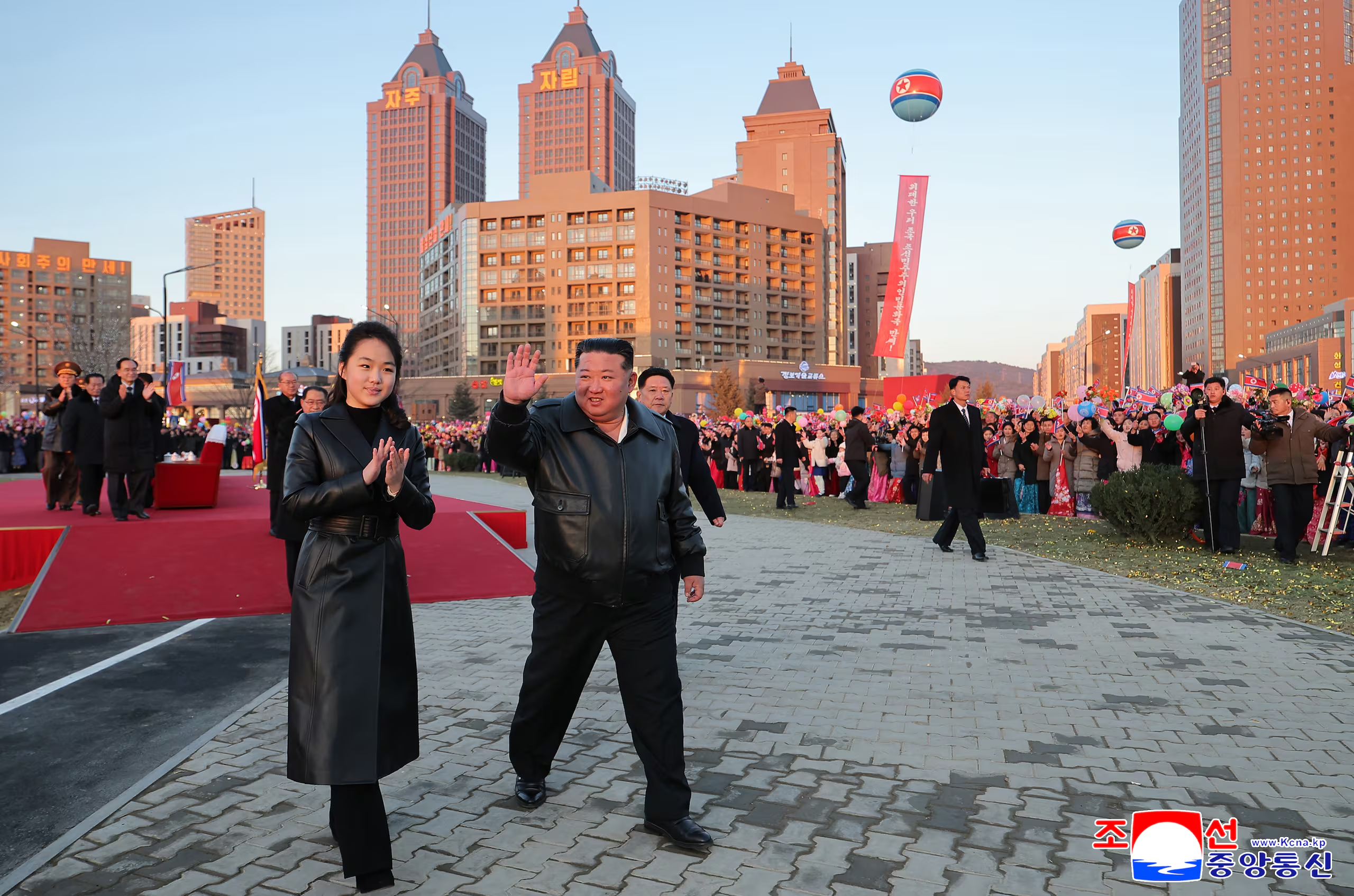

The North Korea housing project completion has reached a major milestone with 50,000 new housing units delivered in Pyongyang. Consequently, this achievement fulfills a key commitment made during the Workers’ Party’s 8th Congress in early 2021. Indeed, the successful delivery of these residences represents a significant domestic policy accomplishment for the regime. Furthermore, the project’s conclusion coincides with heightened public attention on leader Kim Jong-un’s daughter, Kim Ju-ae, who made rare appearances interacting with ordinary residents during completion ceremonies.
Moreover, the North Korea housing project completion unfolded through sequential development across multiple districts northeast of the capital. Specifically, construction began in the Soksong-Songhwa District before advancing to the Hwasong District in phased segments. Therefore, the fourth and final phase of the Hwasong District, comprising 10,000 households, was finalized after construction commenced in February 2025. Additionally, official reports indicate the initiative exceeded its original target, establishing nearly 60,000 households rather than the planned 50,000. Consequently, state media characterized the effort as a “monumental five-year struggle” that created new standards for Juche architecture. Indeed, these claims position the project as a model for future construction endeavors across the country.
Furthermore, the North Korea housing project completion ceremony featured leader Kim Jong-un alongside his daughter Kim Ju-ae in scenes that attracted international attention. Specifically, photographs showed Kim Ju-ae embracing newly settled residents and exchanging congratulations during the ribbon-cutting event. Therefore, these images marked a departure from typical state media portrayals that usually limit her appearances to formal settings with high-ranking officials. Moreover, the Rodong Sinmun, North Korea’s primary newspaper, prominently featured these interactions, suggesting intentional messaging. Consequently, analysts interpret this visibility as an effort to strengthen Kim Ju-ae’s public image ahead of the upcoming 9th Party Congress. Indeed, such symbolic gestures often precede significant political transitions within the regime.
Additionally, the North Korea housing project completion carries implications beyond domestic infrastructure development. For instance, Yang Moo-jin, a distinguished professor at the University of North Korean Studies, noted that showcasing Kim Ju-ae engaging with citizens reinforces the leadership’s “people-first” revolutionary ideology. Therefore, these visual narratives serve dual purposes: celebrating policy achievements while subtly advancing succession-related messaging. Moreover, recent reports from South Korea’s National Intelligence Service indicate Kim Ju-ae has begun offering input on certain policy matters. Consequently, observers view her expanding public role as evidence of gradual preparation for future leadership responsibilities. Indeed, balancing family imagery with political signaling represents a delicate strategic calculation for the regime.
In addition, the North Korea housing project completion reflects broader priorities in urban planning and resource allocation. Specifically, concentrating new housing in Pyongyang reinforces the capital’s status as the nation’s political and economic center. Therefore, this focus may exacerbate disparities between urban and rural living conditions across the country. Moreover, the emphasis on architectural standards and model districts suggests ambitions to showcase developmental progress to both domestic and international audiences. Consequently, the project’s symbolism may outweigh its practical impact on nationwide housing shortages. Indeed, state media framing consistently presents these achievements as evidence of systemic strength under current leadership.
Additionally, the North Korea housing project completion occurred alongside statements outlining future policy directions. Specifically, Kim Jong-un declared that more ambitious goals for progress and creation would be specified at the 9th Party Congress. Therefore, the housing initiative serves as both a concluding achievement for the current party term and a foundation for upcoming commitments. Moreover, the leader expressed resolve to renew the entire capital region in the spirit of a new era. Consequently, observers anticipate continued emphasis on visible infrastructure projects as markers of regime legitimacy. Indeed, such announcements often precede periods of intensified domestic mobilization and resource allocation.
Furthermore, the North Korea housing project completion invites scrutiny regarding implementation methods and resource sourcing. For instance, large-scale construction initiatives in North Korea frequently rely on military labor and centralized resource distribution. Therefore, questions persist about the economic trade-offs involved in prioritizing urban housing over other developmental needs. Moreover, international sanctions constrain access to certain materials and technologies that could enhance construction efficiency. Consequently, the regime’s ability to deliver such projects despite external pressures remains a point of analytical interest. Indeed, understanding these dynamics provides context for evaluating the sustainability of similar future endeavors.
Looking ahead, the legacy of the North Korea housing project completion will depend on multiple factors. Specifically, the long-term habitability, maintenance, and community integration of these new residences will determine their true impact on residents’ lives. Therefore, follow-up reporting on occupancy rates and living conditions will offer valuable insights beyond official announcements. Moreover, the political trajectory of Kim Ju-ae’s public role may influence how this housing initiative is remembered in historical narratives. Consequently, observers should monitor both practical outcomes and symbolic messaging as the regime approaches its next party congress. Indeed, distinguishing between performative achievements and substantive progress remains essential for accurate assessment.
In summary, the North Korea housing project completion represents a significant domestic policy milestone with multifaceted implications. Consequently, the delivery of tens of thousands of housing units fulfills a key campaign promise while showcasing regime capabilities. Furthermore, the prominent inclusion of Kim Ju-ae in related ceremonies introduces succession-related dimensions to an otherwise infrastructure-focused announcement. Therefore, stakeholders should evaluate both the tangible benefits for residents and the strategic messaging embedded in state media coverage. Moreover, understanding the interplay between domestic development priorities and political symbolism enhances analysis of North Korean governance patterns. Indeed, the North Korea housing project completion offers a valuable case study in how authoritarian regimes leverage infrastructure achievements to reinforce legitimacy and advance broader political objectives. As a result, continued attention to both implementation details and narrative framing will yield deeper insights into the regime’s evolving priorities and methods.
READ: Modular Homes Approved in Northampton Amid School Safeguarding Concerns